Manufacturing
Software Failures in Manufacturing: Why Production Stops When Code Breaks
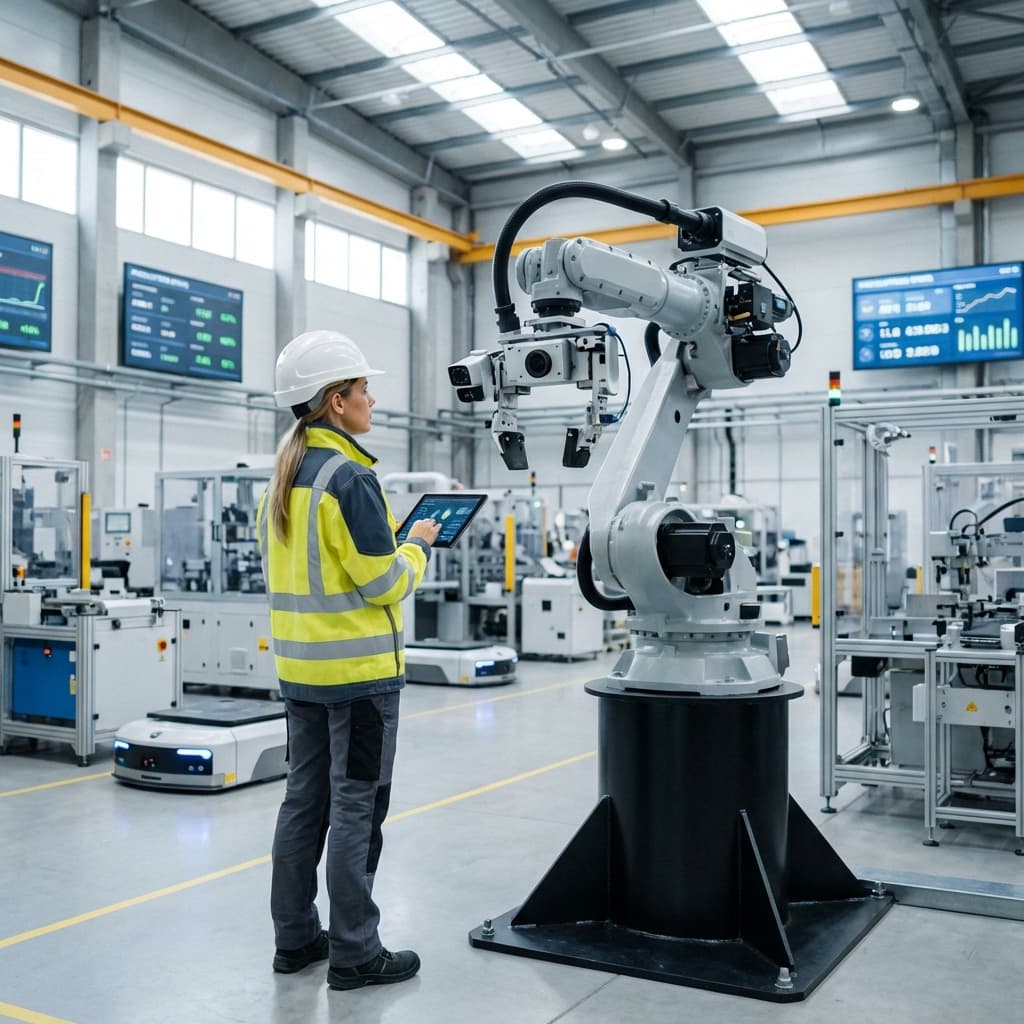
Manufacturing operates on a fundamental principle: consistency. Every unit produced must meet specifications. Every process must execute within tolerances. Every quality check must yield predictable results. This consistency depends increasingly on software—manufacturing execution systems (MES), programmable logic controllers (PLCs), quality management systems, and the constellation of applications that coordinate modern production.
When manufacturing software fails, production stops. Lines go down. Orders are delayed. Defective products escape quality controls and reach customers. The costs are measured not just in downtime, but in scrapped materials, expedited shipping, warranty claims, and lost customer contracts.
Yet the software that controls manufacturing processes is often developed with less rigor than the processes themselves. Quality systems that would never accept a 1% defect rate in physical production routinely accept software built on undocumented assumptions, tested in isolation, and deployed without verification that it will behave correctly under production conditions.
The Hidden Failure Mode: Process Specifications vs. Control Logic
Manufacturing software fails because process engineers and software engineers solve different problems. The process engineer specifies that "temperature shall be maintained at 175°C ± 5°C." The software engineer implements a control loop that reads a temperature sensor and adjusts a heating element. Both believe the requirement has been satisfied.
Then production reveals the gaps. The sensor has a measurement latency of 200 milliseconds—long enough for temperature to overshoot by 8°C before the control loop responds. The heating element has thermal inertia that the control algorithm does not model. The specification assumed continuous control, but the PLC executes discrete samples. The system oscillates outside tolerance on every cycle.
This pattern pervades manufacturing software. Machine specifications describe steady-state behavior without addressing transient conditions. Recipe management systems assume valid inputs without specifying validation rules. Quality inspection algorithms are calibrated on ideal samples without testing on production variance.
The hidden failure mode is not software bugs in the traditional sense. The code may execute exactly as written. The failure is that the code was written to a specification that did not account for the physical realities of production—realities that were obvious to the process engineer but invisible to the software developer.
Why Traditional Tools Do Not Solve This
Manufacturing companies have invested in sophisticated production technology—MES platforms, SCADA systems, ERP integrations, quality management software. These investments optimize production operations without addressing the specification gap.
**MES platforms** orchestrate production workflows, but workflow correctness does not verify control logic. A system can correctly sequence operations while each operation executes incorrectly within its tolerances.
**SCADA systems** monitor and control industrial processes, but they execute the logic they are given. A SCADA system cannot determine whether its control algorithms correctly model physical system dynamics—it can only execute those algorithms.
**ERP integrations** move data between systems, but data integration does not verify data meaning. A production order can pass correctly from ERP to MES while containing recipe parameters that will cause quality failures.
**Quality management systems** track defects and deviations, but they operate after production. By the time a quality system flags a recurring defect, the defective products have been produced and the root cause must be investigated retrospectively.
These tools optimize the execution of manufacturing operations. They do not verify that the specifications driving those operations are complete, consistent, and implementable.
CodeSleuth: A System, Not a Tool
CodeSleuth enforces the discipline that manufacturing software requires: every specification verified against physical reality, every control loop validated against system dynamics, every integration tested under production conditions.
**Discovery** bridges the gap between process specifications and software requirements. The Product Discovery Agent works through control requirements one element at a time. For temperature control, discovery does not stop at "maintain 175°C ± 5°C." It continues: What is the sensor type and measurement latency? What is the heating element response curve? What control algorithm is appropriate for this system? How should the system behave during startup, shutdown, and fault conditions? What happens during power interruptions? What alarms should trigger at what thresholds? Every answer produces a specification that accounts for physical system behavior.
**Planning** translates process requirements into verifiable control designs. The Technical Planning Agent produces artifacts that map each process specification to specific control modules, specific sensor configurations, and specific test scenarios. When an engineer asks "how does the control system handle thermal overshoot," the answer is a traceable reference to specific algorithms and specific validation tests.
**Building** enforces manufacturing-specific quality gates. The Builder Agent is configured with domain-specific validators: all control timing must be verified against sample rates, all sensor readings must be validated against expected ranges, all recipe parameters must pass bounds checking before execution. Every code change passes through gates that verify physical feasibility, not just logical correctness.
**Verification** validates control behavior under realistic conditions. The Verifier Agent generates test artifacts that demonstrate control system performance across operating conditions. For temperature control, evidence includes: step response tests showing transient behavior, steady-state tests demonstrating tolerance compliance, fault injection tests proving graceful degradation. This evidence supports both commissioning validation and ongoing quality assurance.
**Security** addresses operational technology threats. The Security Agent evaluates code against OT-specific risks: control system networks must be segmented from IT networks, PLC firmware must be version-controlled and authenticated, remote access must be logged and restricted. Deployment is blocked if security requirements fail verification.
**Criticism** surfaces the operational risks that project schedules typically defer. The Product Critic Agent identifies gaps between commissioning plans and operational requirements, producing a mandatory record of production risks before deployment rather than during initial production runs.
Industry-Specific Value: Manufacturing
For manufacturing organizations, CodeSleuth addresses the specific risks that define the sector:
**Production continuity**: Manufacturing cannot tolerate unexpected software failures during production. CodeSleuth's verification process ensures that control systems behave correctly across all specified operating conditions, reducing the risk of unplanned downtime.
**Quality system integration**: Quality requirements must be enforced by software, not just monitored by software. CodeSleuth's discovery process ensures that quality inspection logic, tolerance checking, and rejection criteria are fully specified before the quality system is implemented.
**Recipe management reliability**: Multi-product manufacturing depends on accurate recipe execution. CodeSleuth's verification ensures that recipe parameters are correctly interpreted, bounds are enforced, and product changeovers execute without carryover contamination.
**Regulatory compliance verification**: Regulated manufacturing (pharmaceuticals, medical devices, food and beverage) requires validated software. CodeSleuth's artifacts directly support validation protocols, providing contemporaneous evidence of verification rather than retrospective documentation.
**OT security assurance**: Industrial control systems are increasingly targeted by cyber threats. CodeSleuth's security review ensures that control system access, network segmentation, and firmware integrity protections are implemented before production deployment.
The Consequences of Inaction
The consequences of manufacturing software failures are immediate and measurable.
**Production consequences** are direct. When control software fails, production stops. Downtime costs in high-volume manufacturing can exceed $20,000 per minute. Even short interruptions cascade through supply chains, affecting customer deliveries and contract compliance.
**Quality consequences** compound. Defective products that escape quality controls generate warranty claims, recalls, and liability exposure. In regulated industries (automotive, aerospace, food, pharmaceuticals), quality escapes can trigger regulatory enforcement and market access restrictions.
**Safety consequences** are severe. Industrial control failures can create hazardous conditions—equipment operating outside safe parameters, safety interlocks bypassed, operators exposed to uncontrolled processes. The consequences range from injuries to fatalities.
**Competitive consequences** persist. Manufacturers with unreliable software lose customer confidence. Customers who experience quality failures or delivery delays do not return willingly. The cost of acquiring new customers makes retention essential, and software failures destroy the operational reliability that retention requires.
**Security consequences** are escalating. Ransomware attacks targeting manufacturing operations have shut down production facilities worldwide. The attack surface of connected manufacturing provides adversaries multiple entry points. The consequences of successful attacks include not just production disruption but intellectual property theft and safety system compromise.
Organizations that continue to deploy manufacturing software without systematic verification against physical system requirements are accepting operational risk they have not measured—because they have not verified the assumptions on which their control systems depend.
Who This Is For
CodeSleuth is designed for manufacturing organizations that recognize the gap between their process requirements and their software implementation.
It is for:
- Discrete manufacturers deploying MES, quality, and production management systems
- Process manufacturers implementing control systems for chemical, pharmaceutical, or food production
- Automotive and aerospace suppliers subject to quality system requirements (IATF 16949, AS9100)
- Industrial equipment manufacturers building control systems into their products
- Manufacturing organizations that have experienced production disruptions caused by software failures
It is not for organizations building prototype systems where production reliability is not yet a requirement. It is not for research facilities where experimental flexibility outweighs operational consistency. It is not for projects where control system specifications are still evolving.
CodeSleuth is the system that ensures manufacturing software meets the same quality standards as manufacturing processes. For organizations ready to close the gap between process specifications and control system implementation, it is the foundation for software that production depends upon.
Ready to Transform Manufacturing Software?
Discover how CodeSleuth's multi-agent architecture can enforce the discipline your manufacturing organization demands.
Explore Other Industries
See how CodeSleuth works across different sectors